
Neu: Hybridausgaben
Ab sofort bieten wir viele unserer Verlagsausgaben auch in hybrider Form an:
Sie erhalten das komplette PDF-Set sowie eine gedruckte Partitur.
Versandkostenfrei in Österreich und der EU.
Die Hybridoption ist im Bestellvorgang ersichtlich.
NUR IM ORCHESTRALART WEBSHOP ERHÄLTLICH!
Verwerfen


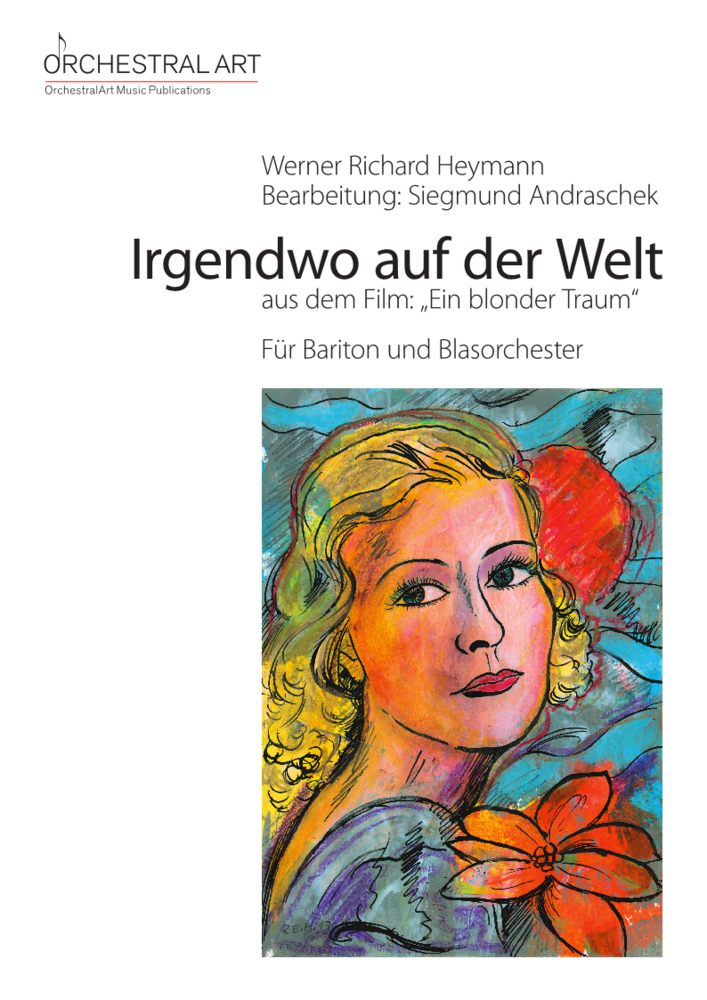
Irgendwo auf der Welt
25,00 € – 125,00 €Preisspanne: 25,00 € bis 125,00 € inkl. MwSt.
„Irgendwo auf der Welt gibt’s ein kleines bisschen Glück“.
Diesen langsamen Foxtrott komponierte Werner Richard Heymann für den UFA-Tonfilm „Der blonde Traum“ im Jahr 1932.
Während für die Schauspielerin Lilian Harvey das Glück begann und während die Kritik sie euphorisch lobte, musste Werner Richard Heymann als Jude sein Heimatland verlassen.
Das Lied allerdings drückt das Zeitgefühl aus. 1933 wurde Heymann wegen seiner jüdischen Abstammung von der UFA gekündigt.
Er ging in die Emigration, zuerst nach Paris und später nach Hollywood. In Hollywood komponierte er mit großem Erfolg zahlreiche Filmmusiken, unter anderem 1939 für den Ernst Lubitsch-Film „Ninotschka“ mit Greta Garbo.
Für sein Filmusikschaffen wurde er mehrmals für den Oscar nominiert.
Im Jahre 1951 kehrte Heymann nach Deutschland zurück, wo er sich weiterhin dem Komponieren widmete. Heymann starb 1961 in München.
Er ist auf dem Münchener Waldfriedhof begraben.
“Somewhere in the World There’s a Little Bit of Happiness”
This slow foxtrot was composed by Werner Richard Heymann for the UFA sound film Der blonde Traum (The Blonde Dream) in 1932.
While the film marked the rise of actress Lilian Harvey, earning her enthusiastic praise from critics, Heymann—being Jewish—was forced to leave his homeland. Despite the song’s hopeful tone, it reflected the spirit of a time overshadowed by looming darkness. In 1933, Heymann was dismissed from UFA due to his Jewish heritage.
He went into exile, first to Paris, then later to Hollywood, where he achieved great success composing numerous film scores. Notably, in 1939, he composed the music for Ernst Lubitsch’s film Ninotchka, starring Greta Garbo.
Heymann received multiple Academy Award nominations for his film music during his career.
In 1951, he returned to Germany, where he continued composing. Heymann passed away in 1961 in Munich, and is buried in the Munich Waldfriedhof.
Theodor Doehler – Ein Marsch für jede Gelegenheit
Iris Vonolfen – Funk and the Fugue
Florian Moitzi – Freedom of Mind
Siegmund Andraschek – Glick