
Neu: Hybridausgaben
Ab sofort bieten wir viele unserer Verlagsausgaben auch in hybrider Form an:
Sie erhalten das komplette PDF-Set sowie eine gedruckte Partitur.
Versandkostenfrei in Österreich und der EU.
Die Hybridoption ist im Bestellvorgang ersichtlich.
NUR IM ORCHESTRALART WEBSHOP ERHÄLTLICH!
Verwerfen


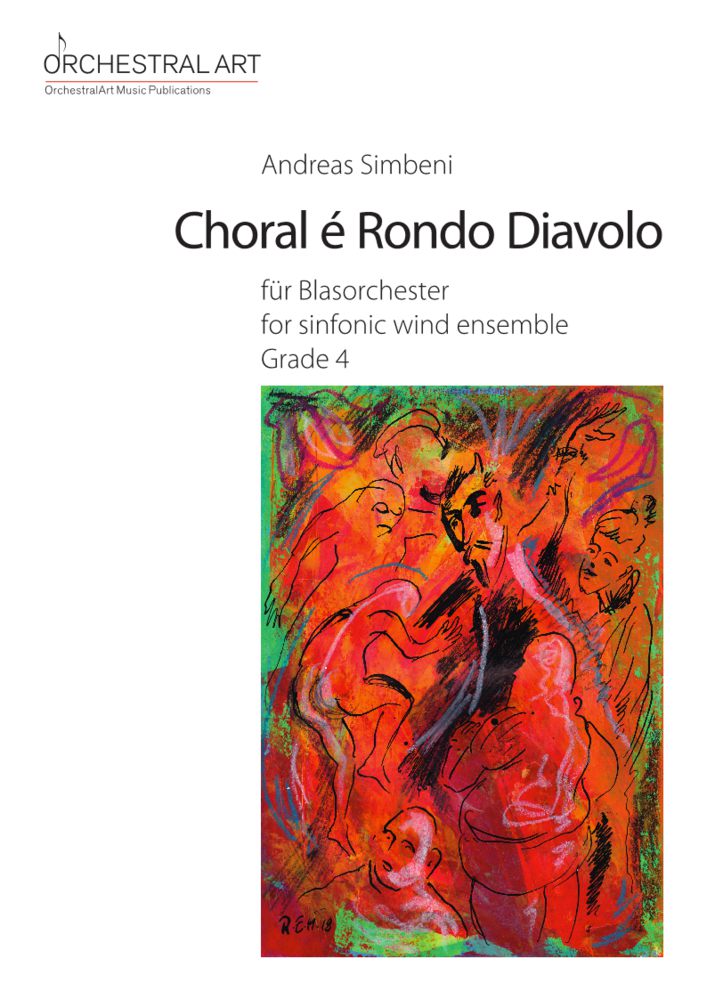
Choral é Rondo Diavolo
25,00 € – 125,00 €Preisspanne: 25,00 € bis 125,00 € inkl. MwSt.
Schon lange war es mir ein Bedürfnis, ein Werk zu komponieren, abseits der im Blasorchester Repertoire üblichen Programtischen Betitelungen – Musik einfach der Musik halber wegen.
Einerseits war es die Gattung des Chorals, die gerade für Blasorchester eine so klangbildende Vorbildwirkung hat, wobei hier bewusst das wechselnde Metrum als herausforderndes und auch bereicherndes Element verwendet wird. Andererseits die Form des Rondos, in der mit einfachsten Mitteln und einer sich stets leicht verändernden Instrumentation, die von permanenter, nie banal wirkender Wiedererkennungskultur geprägt ist, spannende Musik entstehen kann.
Dieser Choral beruht auf einer äolischen Melodie, wobei am Ende der ersten Phrase die ersten drei Töne vom A Themas des Rondos in der aufsteigenden Einwurfs Sequenz zitiert werden.
Das sich in Takt 16 kurz ankündigende C – Dur wird dann jedoch sofort im Takt 20 durch einen auf der offen auf C aufgebauten Quint erklingenden verminderten Dreiklang wieder relativiert. Letztendlich leiten die in leichter polyphoner Manier einsetzenden Einwurfs Sequenzen ins Rondo über.
Das Rondo mit der Form A – B – A – C – A – D – A – C – A – B – A´ – Coda in c – moll, zitiert in seinem D Teil die Melodie des Chorals wieder,
wobei die Duolen in Polyrhythmischer Konkurrenz, zur sich ständig in Tempo und Intensität steigernden 6/8 Struktur, stehen.
(Andreas Simbeni, September 2018)
For a long time, I felt the need to compose a work apart from the usual programmatic titles common in wind orchestra repertoire — music simply for the sake of music.
On the one hand, it was the genre of the chorale, which has such a formative influence on the sound of wind orchestras. Here, the deliberately changing meter is used as a challenging and enriching element. On the other hand, the form of the rondo, in which exciting music can emerge with the simplest means and a constantly slightly changing instrumentation, characterized by a culture of continuous and never banal recognition.
This chorale is based on an Aeolian melody, with the first three notes of the rondo’s A theme quoted in the ascending introductory sequence at the end of the first phrase.
The C major that briefly appears in bar 16 is immediately relativized in bar 20 by a diminished triad built on an open quint on C. Ultimately, the introductory sequences, which begin in a lightly polyphonic manner, lead into the rondo.
The rondo, with the form A – B – A – C – A – D – A – C – A – B – A´ – Coda in C minor, quotes the melody of the chorale again in its D section.
The duplets stand in polyrhythmic competition with the 6/8 structure, which constantly increases in tempo and intensity.
(Andreas Simbeni, September 2018)
Peter Diesenberger – Dahoam
Peter Diesenberger – Sonorous
Thomas Asanger – Klek Mountain
Matthias Achleitner – Musikerleben